Do you remember Abbott and Costello’s classic “who’s on first” comedy routine? Offer clarity in marketing can be like that comedy bit…but without the funny part. For those of you who AREN’T from the 1900s, I’ll explain: Abbott and Costello are talking, but not understanding each other. Or just watch this clip.
Abbott is being completely precise. From his own vantage point, “Who,” “What,” and “I Don’t Know” are literally the names of baseball players. Costello doesn’t have that context, so what sounds obvious to Abbott is NOT answering Costello’s questions. Kyle at Chief Go Officers was facing a similar problem. But instead of baseball players’ names, his offer was confusing to potential customers.
Don’t have time to read this post? Watch the video here!
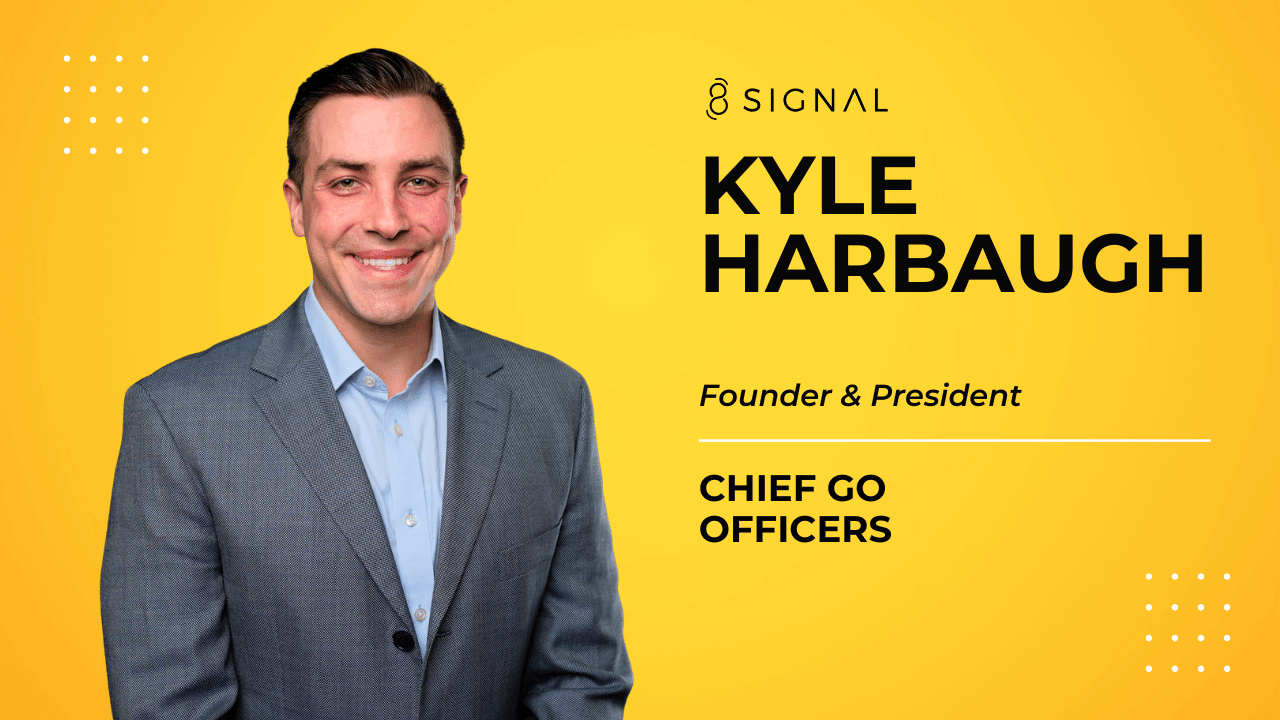
Kyle Harbaugh is the co-founder and president of Chief Go Officers, where he helps service-based professionals use AI and fractional services to scale, exit, or build businesses that run well without them. He spends his career helping other people see the parts of their business they can’t see themselves. But sometimes things that make perfect sense to you… don’t make sense to people without your context.
The need for an outside perspective was Chief Go Officers’ biggest constraint. But Kyle wasn’t even aware of it until he spent thirty days with a Fractional CMO for EOS companies.
Let’s walk through what changed, and why the solution to the marketing “Who’s on first” problem was an outside perspective.
Why Does Your Offer Make Perfect Sense to You But Not Your Customers?
There’s a name for what happened to Kyle (and to Abbott and Costello). Psychologists call it the “curse of knowledge”: once you know something, it’s almost impossible to imagine NOT knowing it. In a well-known Stanford study, people tapped out the rhythm of a familiar song, like “Happy Birthday,” on a table and predicted that listeners would recognize the tune about half the time. Listeners actually got it right 2.5% of the time. The tappers could hear the song in their head. Everyone else just heard tapping.
When we audit a business’s messaging at 8 SIGNAL, that blasted curse of knowledge shows up (often). The founder’s explanation seems solid to the founder, and confusing to those hearing it for the first time. Kyle THOUGHT his offer was water-tight. It made total sense…to him. He was the “Happy Birthday tapper.” Prospects hearing it were struggling to understand what he was pitching.
Why Tactics Can’t Solve a Clarity Problem
Plenty of other marketers offered to fix Kyle’s website or run SEO.
But a better website or sharper ad can’t fix a confusing offer.
That’s tactical work, useful on its own terms, but it assumes the underlying offer is already clear. If your marketing conversations only ever happen at the tactical level (better copy, a new logo, another ad push) that’s often a sign nobody has stress-tested the offer underneath it yet. We’ve said it once, and we’ll say it again (actually probably two hundred more times): strategy leads, tactics follow.
Strategy was the piece needed to connect Kyle’s offer with his customers.
What Is the Customer Value Journey and Why Does It Fix Confusing Offers?
Kyle’s team runs on EOS, which meant that he wanted his marketing to run on EOS too. One operating system, no translation required between Visionary, Integrator, and Marketing Integrator.
That shared language is what made the next part land. Kyle’s team was handed a framework called the Customer Value Journey: a map of how a prospect moves from first hearing about a business to becoming a confident customer, and what that prospect needs to understand at each stage along the way. It forces a business to explain its value in the prospect’s language, not the founder’s.
“After working with 8 SIGNAL, my strategy and how I’ve approached marketing has really changed. One of the things that Ruben showed me was the customer value journey, and how that framework really influenced the way I look at marketing and how we present ourselves to the customer.” Kyle Harbaugh, Co-Founder & President, Chief Go Officers
That’s exactly the role a Fractional CMO for EOS companies plays inside a business that already has EOS running underneath it: translating what the Visionary and Integrator already know into language a first-time prospect can actually follow.
What Changed When Kyle Got an Outside Perspective
Thirty days into working with an 8 SIGNAL Fractional CMO, Kyle had a clear view of his customer and the journey that person must take from total stranger to becoming your biggest fan. He understood how to talk with his ICP (ideal client profile) so that his offer communicated the value they provide. The result wasn’t only a clearer, simplified pitch. He told us:
“I loved working with 8 SIGNAL because it made my life simpler. I feel so much better about having a clear, easy-to-understand product, packaged nicely.”
Strategic clarity doesn’t just help prospective customers understand you. It makes the whole business easier to run.
Thinking Outside the (Marketing) Box
Abbott never sounded confusing to himself. Neither did Kyle’s original offer (at least not to Kyle). Getting an outside perspective from a marketing expert who asks the right questions is often the only way out of that loop. For Kyle, that reframe changed how his company talks to every prospect it meets, not just one marketing document.
If your offer makes perfect sense to you and you’re not sure whether it makes sense to anyone else, that’s exactly the kind of gap an 8 SIGNAL Fractional CMO is built to find. Reach out and let’s build clarity for your business.
FAQs
The clearest sign your marketing offer is unclear is when your explanation feels obvious to you but prospects keep asking basic clarifying questions anyway. That gap, between how simple it feels internally and how confusing it sounds externally, is the curse of knowledge at work. If your explanation leans on insider shorthand, your team’s language, unstated assumptions, or jargon you stopped noticing, your prospects are probably confused and you could likely benefit from an outside perspective.
EOS companies need a Fractional CMO because EOS provides the operating system for running a business, but it doesn’t include a framework for communicating the business’s offer to prospects. That gap is nearly impossible to close from inside the business. A Fractional CMO for EOS companies brings the outside perspective that’s nearly impossible to generate internally, plus a marketing leadership seat most EOS companies haven’t built yet.
In marketing, the curse of knowledge is a cognitive bias that causes businesses to communicate their offer in language that makes perfect sense to them (but confuses the prospects they’re trying to reach). That means the language, examples, and assumptions that feel obvious to the person who built the offer often aren’t obvious at all to a prospect encountering it for the first time. This is one reason why the outside perspective of a Fractional CMO is so valuable.
The Customer Value Journey is the framework 8 SIGNAL uses to map how a prospect moves from first hearing about a business to becoming a confident customer (and what that prospect needs to understand at each stage along the way). It enables a business to articulate its value in ways that connect with their target audience at each stage of engagement.
A Fractional CMO operates as embedded marketing leadership, setting strategy and holding a seat in the business’s operating rhythm (Level 10 meetings, Rocks, scorecards), while a consultant typically delivers a project and moves on. The difference is that a Fractional CMO is part of your leadership team and is accountable for outcomes.